
Let’s compare a traditional insurance policy with a Nifty50 index fund.

Key Finding: The Nifty 50 investment becomes superior at age 64, providing significantly higher real income throughout most of retirement. The insurance plan only offers a slight advantage in the first 4 years of retirement.
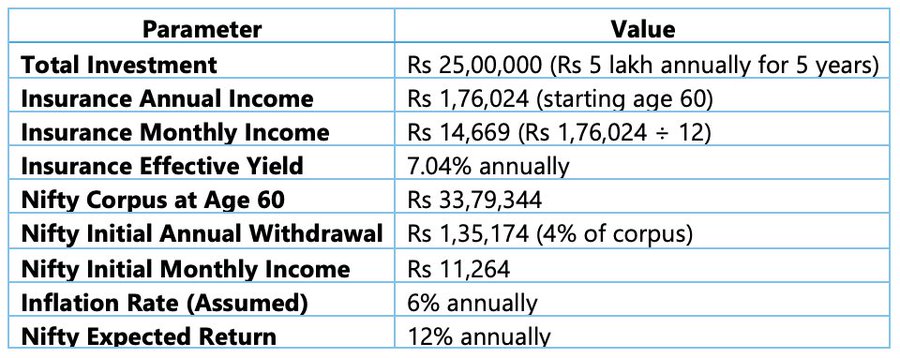
Investment Parameters
Monthly Income Analysis (Real Values)
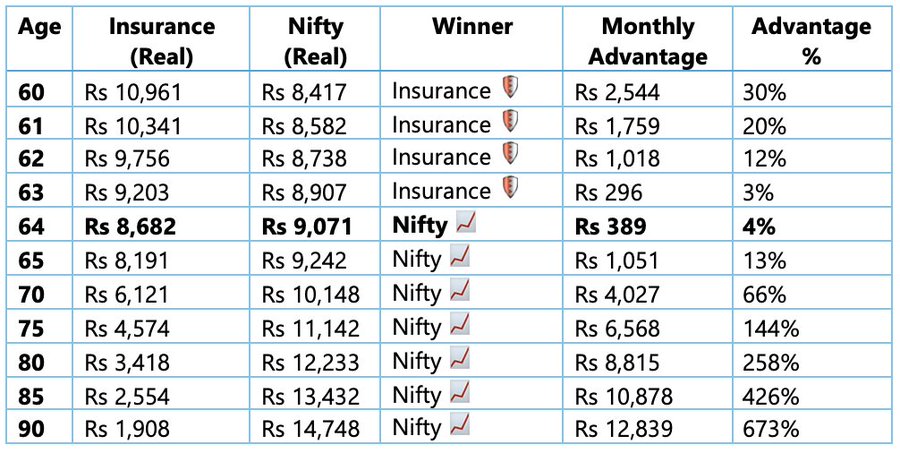
*All values adjusted for 6% annual inflation to 2025 purchasing power
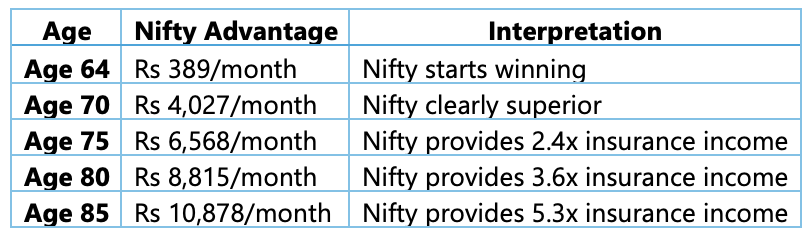
🏆 Winner Analysis
Nifty 50 Dominates After Age 64
- Breakeven occurs at age 64 (just 4 years into retirement)
- Provides dramatically higher real income for the majority of retirement
- At age 75, Nifty delivers 144% more real income than insurance
- At age 85, Nifty delivers 426% more real income than insurance
📊 Breakeven Point
Age 64: Nifty 50 starts exceeding insurance income
- Nifty real income: Rs 9,071
- Insurance real income: Rs 8,682
- Nifty corpus at breakeven: Rs 45,97,561
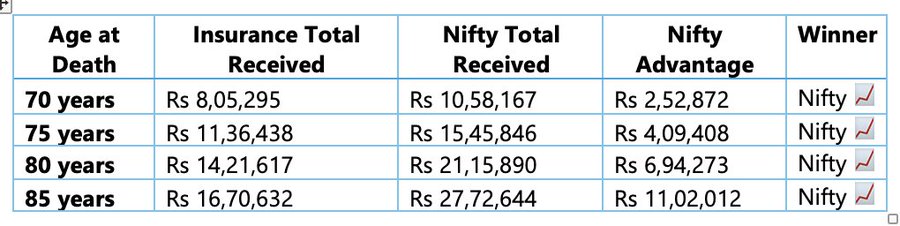
💰 Long-term Wealth Impact
Cumulative Income Analysis (Real Terms)
Investment Recommendation Matrix
Choose Nifty 50 If:
- ✅ Normal Risk Tolerance – Historical equity returns are well-established
- ✅ Typical Retirement – Planning for 20-30 year retirement (age 60-85)
- ✅ Inflation Protection – Want growing real income over time
- ✅ Wealth Building – Prefer wealth accumulation over guaranteed income
- ✅ Legacy Planning – Want to leave a substantial corpus to heirs
- ✅ Liquidity Needs – May need access to principal for emergencies
Choose Insurance Plan If:
- 🛡️ Extreme Risk Aversion – Cannot tolerate any market volatility
- 🛡️ Very Short Retirement – Expect to live only 60-65 years
- 🛡️ Guaranteed Income Priority – Value certainty over returns
- 🛡️ Simplicity – Want a completely hands-off investment
- 🛡️ Poor Health – Expect below-average lifespan
Critical Analysis: Why Nifty 50 Wins
1. Low Insurance Yield
- 7.04% effective annual return is relatively modest
- Barely keeps pace with inflation expectations
- No growth component to combat long-term inflation
2. Compound Growth Power
- Nifty corpus continues growing even during the withdrawal phase
- Net 8% growth (12% return – 4% withdrawal) compounds powerfully
- Creates an accelerating income gap over time
3. Inflation Protection
- Fixed insurance income loses 50% purchasing power in 12 years
- Growing Nifty withdrawals maintain and increase purchasing power
- Real income gap widens dramatically over time
4. Wealth Preservation
- Insurance plan: Zero wealth remaining after death
- Nifty plan: Substantial corpus remains for heirs (likely Rs 50+ lakhs)
Optimal Strategies
Recommended: Pure Nifty 50 Approach
- Invest full Rs 25 lakhs in the Nifty 50 index fund
- Follow 4% withdrawal rule starting at age 60
- Provides superior income for 96% of the retirement period
- Leaves substantial wealth for heirs
Conservative Hybrid (If Risk-Averse)
- 30% Insurance Plan: Rs 7.5 lakhs → Rs 52,807 annual guaranteed income
- 70% Nifty 50: Rs 17.5 lakhs → Growing income starting at Rs 94,621 annually
- Provides base security plus growth potential
Ultra-Conservative (Only if Extremely Risk-Averse)
- 50% Insurance: Rs 12.5 lakhs → Rs 88,012 annual guaranteed income
- 50% Nifty: Rs 12.5 lakhs → Rs 67,587 initial annual income
- Balanced but sacrifices significant long-term returns
Conclusion
The analysis reveals the Nifty 50 as the clear winner for retirement planning. The insurance plan’s 7.04% annual yield is simply too low to compete with equity market returns over a typical 25-30 year retirement period.
Key Takeaways:
- Breakeven occurs quickly – Just 4 years into retirement
- Income gap widens dramatically – Nifty provides 6x more income by age 85
- Wealth preservation – Nifty leaves a substantial corpus for heirs
- Inflation protection – Growing income vs. fixed income
Bottom Line: Unless you’re extremely risk-averse or expect a very short retirement, the Nifty 50 strategy provides superior outcomes in almost every scenario. The insurance plan’s low yield makes it unsuitable for long-term wealth building and generating retirement income.
Recommendation: Invest the full Rs 25 lakhs in a Nifty 50 index fund and follow the 4% withdrawal rule for optimal retirement outcomes.